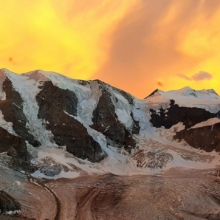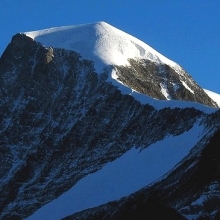
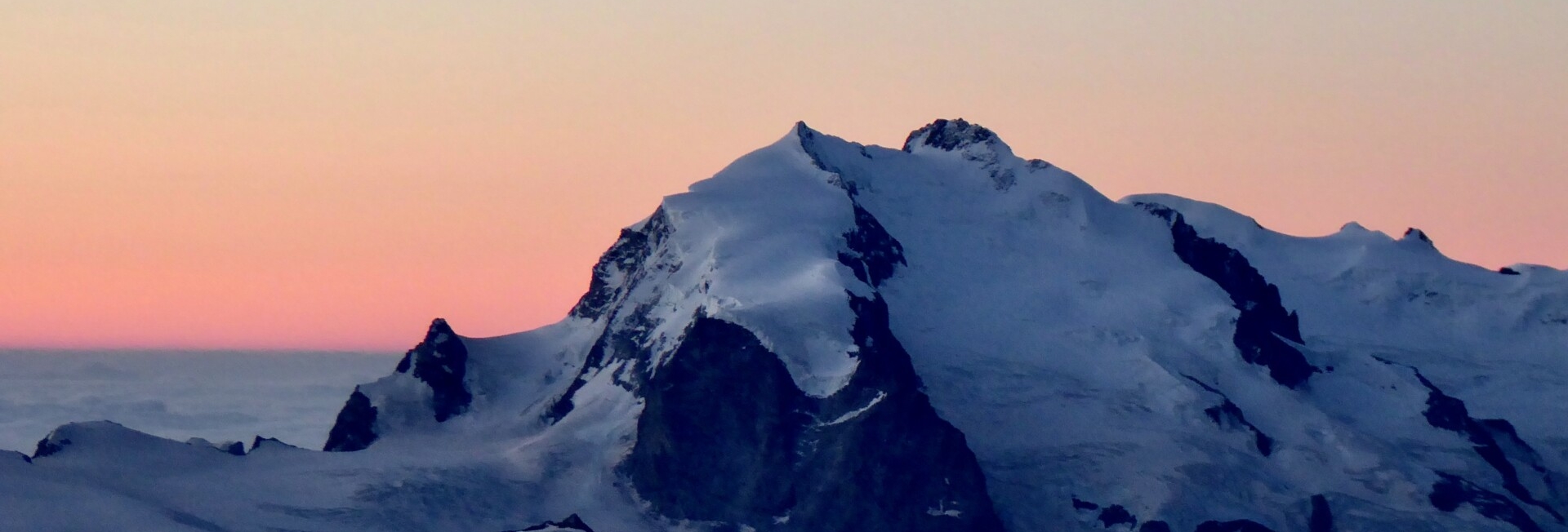

Dufourspitze – Roof of the Valais Alps
The second highest peak in the Alps - a majestic place where all lines converge.
Fitness

 Du bist ein Genießer, du liebst es gemütlich. 2 bis 3 Stunden Gesamtzeit sind kein Problem für dich.
 Du magst gemütliche Touren, kannst auch etwas drüber hinausgehen. Bis zu 5 Stunden Gesamtzeit schaffst du gut.
 Du bist schon etwas ambitionierter und es macht dir nichts aus, dich 6 bis 7 Stunden auf Tour zu bewegen.
 Deine Ausdauer ist sehr gut, du bist nach einer 8- bis 9-stündigen Tour noch nicht „ausgepowert“.
Deine Kondition ist überdurchschnittlich gut und du kannst nach 9 bis 10 Stunden auf Tour immer noch entspannt dein Bier genießen.
Beachte bitte auch, dass für diese konditionelle Bewertung eine Leistung von mindestens 300 (bei Touren ab Schwierigkeitsbewertung  mindestens 400, ab
  mindestens 500) Höhenmetern in der Stunde (im Aufstieg am Wanderweg ohne schweres Gepäck) Voraussetzung ist.
You enjoy walks, you like it unhurried. 2 to 3 hours of walking time are no issue for you.
You like unhurried walks but do appreciate something more challenging. 5 hours walking time are finde with you.
You are already a bit ambitious and you don’t mind 6 to 7 hours walking time.
You are in great shape, 8 to 9 hours of walking / climbing are not your limit.
You are physical fitness is way beyond average, even after 9 to 10 hours of walking / climbing you will enjoy your beer with a smile.
Please consider the minimum climbing rate based on these degrees of fitness 300 m or 1000 ft vertical per hour. From level and higher it is 500 m or 1500 ft vertical per hour, both with light backpacks.
Technic
 In der untersten Schwierigkeitsstufe bewegst du dich an der Grenze zwischen Piste und freiem Skiraum.
Du kannst mit diesem Eigenkönnen schon an meinen „Geführten Skitouren für Anfänger“ teilnehmen.
Wenn du dich steigern möchtest, empfehle ich dir den Kurs „Schnupperskitouren – von der Piste ins Gelände“.
In der untersten Schwierigkeitsstufe bewegst du dich an der Grenze zwischen Piste und freiem Skiraum.
Du kannst mit diesem Eigenkönnen schon an meinen „Geführten Skitouren für Anfänger“ teilnehmen.
Wenn du dich steigern möchtest, empfehle ich dir den Kurs „Schnupperskitouren – von der Piste ins Gelände“.
 Du beherrschst den sicheren Stemmschwung in jeder Schneeart in sanftem, maximal wenig mehr als
30° geneigtem Gelände. Im Aufstieg kommen keine oder nur vereinzelte Spitzkehren vor.
Du beherrschst den sicheren Stemmschwung in jeder Schneeart in sanftem, maximal wenig mehr als
30° geneigtem Gelände. Im Aufstieg kommen keine oder nur vereinzelte Spitzkehren vor.
 In gelegentlichen Steilstücken von 30 bis 35° bereitet dir der sichere Stemmschwung keine Probleme.
Für den Aufstieg benötigst du Spitzkehrentechnik.
In gelegentlichen Steilstücken von 30 bis 35° bereitet dir der sichere Stemmschwung keine Probleme.
Für den Aufstieg benötigst du Spitzkehrentechnik.
In mäßig geneigtem Gelände schwingst du parallel, häufige Steilpassagen um 35°, gelegentlich auch mehr,
schaffst du mit sicherem Stemmschwung. Im Aufstieg ist auf deine Spitzkehren Verlass.
Vereinzelte Tragepassagen bis zu 40° meisterst du mit Steigeisen.
Leichte Kletterstellen* (max. UIAA I–II) sind für dich gut machbar.
Du bist ein sehr guter Skifahrer und beherrschst den Stemm- oder Parallelschwung in jeder Schneeart
auf einer durchschnittlichen Hangneigung von 35 bis 40°. Du bist in punkto Spitzkehrentechnik auch im
exponierten Gelände sattelfest. Häufige Tragepassagen um die 40° mit Steigeisen wie auch gelegentliche
Kletterstellen* (max. UIAA II) nehmen dir nicht den Mut.
*I. a. nicht obligatorisch.
In the lowest difficulty level, you move on the border between ski run and off-piste area. You can already participate in my “guided ski tours for beginners” with this own skills. If you want to improve, I recommend you the course “Skitours for Beginners – from Piste to Off-Piste”.
You mastered the safe stem turn in each type of snow in gentle, max. little more than 30 ° inclined terrain. In ascent, there are no or only occasional switchbacks.
In occasional steep sections of 30 to 35 °, the safe stem turn does not cause you any problems. For the ascent you need switchback technique.
In moderately sloping terrain you ski in parallel, frequent steep passages around 35 °, occasionally more, you can do with a safe stem turn. On the ascent your switchbacks are reliable. Occasional carrying passages up to 40 ° you overcome with crampons. Lightweight climbing sections * (max UIAA I-II) are possible for you.
You are a very good skier and master the stem or parallel turn in any type of snow on an average slope of 35 to 40 °. You are also saddle-fast in the exposed area when it comes to switchback technique. Frequent carrying passages around 40 ° with crampons as well as occasional climbing sections * (max. UIAA II) do not take the courage.
*In general not obligatory.
Es sind keine speziellen Techniken notwendig. Etwas Trittsicherheit bringst du mit.
Du beherrscht das Gehen mit Steigeisen in gelegentlichen Gletscherpassagen mit 30 bis 35° Neigung.
Auch wenn sich steile Gletscher- oder Firnpassagen von 30 bis 35° häufen, bewegst du dich sicher. Dein Technikrepertoire schließt (ab dieser Schwierigkeitsstufe) das Steigen mit Frontalzacken ein. Vereinzelte leichte Kletterstellen (max. UIAA I bis II) überwindest du zügig.
Obwohl der Großteil der Tour in steilem Gletscher- oder Firngelände von durchschnittlich 35°, manchmal auch 40° verläuft, fühlst du dich noch wohl. Mittelschwere Kletterstellen (UIAA II bis III) meisterst du ohne lange zu überlegen.
In der höchsten Schwierigkeitsstufe ist eine absolut sichere Frontalzackentechnik obligatorisch. Du musst Gletscher- oder Firnpassagen bis zu 45°, vereinzelt bis zu 50° überwinden. Du bist ein guter Felskletterer, der sich vor schwierigen Schlüsselstellen (max. UIAA III bis IV) nicht scheut.
No specific skills necessary, just the usual sure-footedness.
You are able to climb and descend with crampons on occasional glaciers of up to 30 to 35 degrees slopes.
Even in frequent 35 degrees glacier slopes you feel confident. From this degree of difficulty on you can reliably use your front points. You manage occasional easy climbing difficulties (UIAA I – II) without hesitation.
Even though most of the tour you will be exposed to steep glacier and snow slopes of 35 up to 40 degrees you are comfortable with that. You routinely manage medium climbing difficulties (UIAA II – III).
The highest level of difficulty requires superior front point technique. You will have to deal with glacier and snow slopes beyond 45 and up to 50 degrees. You are a good rock climber not hesitating to deal with difficulties of (UIAA III – IV).
maximum participants: 2
Prices: Per participant: € 990 (for 2 persons), € 1,650 (for 1 person)
Included: Full coordination, cabin reservations
Tour Description
Guided high-altitude tour to Switzerland’s highest peak: The state-certified mountain guides of the Firngrat team will lead you to the historic Dufourspitze in the Monte Rosa massif. This classic mountain tour in the Valais Alps begins in the early morning hours at the legendary Monte Rosa Hut near Zermatt: By the light of our headlamps, we make our way as a rope team across the Monte Rosa Glacier to the West Ridge. An enjoyable ridge climb then takes us up to the summit of this majestic 4,000-meter peak—a fantastic route for challenging mountaineering that demands endurance and rewards you with a boundless panorama.
Meeting point: Neue Monte Rosa Hütte, Zermatt, Schweiz
Tour Character
Combined high tour with long glacier passage and moderately difficult ridge climbing.
Required Skill and Fitness Level
Skill: Absolute surefootedness in easy, partly exposed rocky terrain. The prerequisite is rapid climbing in I. and II. UIAA degree of difficulty (both in ascent and descent). There may be occasional III degree passages.
Fitness: Excellent stamina is essential! You should be able to easily climb 500 meters of altitude per hour on a hiking trail without reaching your limits.
Details
-
Group size: Maximum of 2 people per mountain guide for your optimum safety and supervision.
-
Included: Complete organization, reservations of the hut as well as the guidance by a state-certified mountain guide.
-
Exclusive: Ride on the Gornergratbahn (Zermatt-Rotenboden), half board and overnight stay at the Monte Rosa hut for you and a share for the mountain guide (CHF 92 per person, price details can be found here).
-
Miscellaneous: You are responsible for taking out appropriate insurance (accident, travel cancellation). Please also read our General Terms and Conditions.
Appointments
Program schedule/tour itinerary
400 m
400 m
3.5 to 4 hours
1800 m or 2200 m (if returning to Zermatt on the same day)
1800 m or 2200 m (if returning to Zermatt on the same day)
9 hours or 12 hours (if returning to Zermatt on the same day)

You might be interested in:
Guided mountaineering tour to Dent Blanche (4,357 m) – The Rock Peak of Valais
Region: Valais, Switzerland (Starting point: Ferpècle / Val d’Hérens)
Prices: €1,595
Zinalrothorn and Obergabelhorn – two difficult Valais Peaks
Region: Valais, Switzerland
Prices: Euro 1990.-